Gunsan columnsHistory & ArchitectureSinheung-dong and Wolmyeongsan Mountain: Alley Humanities6 min read
75-Degree Roofs and Hillside Alleys: Layers of Time from Sinheung-dong to Wolmyeongsan Mountain
From the Japanese-style house in Sinheung-dong to Mallaengi Village and Dongguksa Temple, we walk through the history of the alleys at the foot of Wolmyeongsan Mountain.

The Sinheung-dong and Haemang-dong area lies on the eastern slope of Wolmyeongsan Mountain.
Below one ridge, it holds the mansions of colonial-era large landowners, the hillside alleys of ordinary people and a Japanese-style temple main hall built in 1913. A walk from a garden house on the flat land to hillside Mallaengi Village and the bamboo grove of Dongguksa Temple shows the different layers of life one city holds.
The 5 places in this columnFull list

- Hours
- Always open
- Closed days
- Open all year
- Hours
- Summer 08:00–19:00Winter 08:00–18:00
- Closed days
- Open all year

Japanese-style House in Sinheung-dong, Gunsan (Hirotsu House)
- Hours
- 10:00–17:00Last entry 20 minutes before closing more
- Closed days
- Every Monday
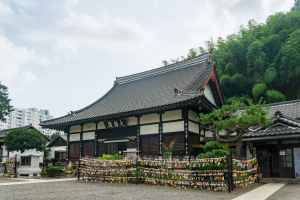
Daeungjeon Hall of Dongguksa Temple, Gunsan
- Hours
- Summer 08:00–19:00Winter 08:00–18:00
- Closed days
- Open all year
- Hours
- 09:00–18:00
- Closed days
- Open all year
Photos: Korea Tourism Organization · KOGL Type 3 (no changes allowed), KOGL Type 1
“The wide Japanese gardens on the flat land and the narrow hillside alleys stand only a few steps apart, showing two faces of the same era.”
A 2-Story Wooden House of Timber and Stone Lanterns in Sinheung-dong
Step inside the walls at 17 Guyeong 1-gil, and an L-shaped 2-story wooden house appears beyond carefully trimmed garden trees and a stone lantern. Under Japanese rule, wealthy residents who ran fabric shops and small farms lived together in Sinheung-dong. Even there, the mansion of the Japanese landowner Hirotsu was by far the largest: the Japanese-style House in Sinheung-dong, Gunsan.
Inside the building are floor-heated rooms, tatami rooms and two Japanese-style gardens, showing the upper-class housing of the time as it was. The house is also widely known as a filming location for the films The General's Son and Tazza: The High Rollers. Entry to the interior is now restricted, and it opens mainly its outer garden and exterior. That suits a slow look at the grain of the wooden eaves along the quiet garden path.
Layers of Daily Life on the 'Mallaengi' Slope
Climb a little from the flat alleys of Sinheung-dong toward the slopes of Wolmyeongsan Mountain, and the density of the scene changes at once. This is Mallaengi Village, named after 'mallaengi', a Jeolla-do dialect word for a hillside or the lower part of a peak.
Under Japanese rule, Korean workers pushed out by the Japanese residential areas on the flat land, such as the Hirotsu House, settled on the hillside. After the Korean War, refugees gathered here, and winding alleys and narrow stairs took shape. Today Mallaengi Village keeps the outer form of its old houses and lives on as a quiet village art museum, with a bookshop, studios for resident artists and a memories exhibition hall.
- Mallaengi VillageHours Always open
Dongguksa Temple's Main Hall, Wrapped by a 75-Degree Roof and a Giant Bamboo Grove
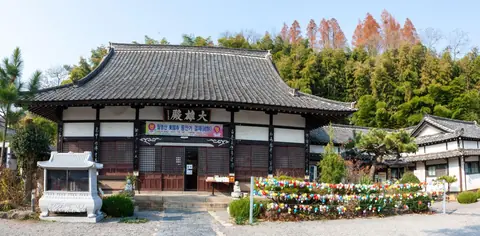
Leave the alleys of Mallaengi Village and turn onto Dongguksa Temple Road, and a straight roofline, quite unlike the curved eaves of traditional Korean temples, appears before you. This is Dongguksa Temple, founded in 1909 by the monk Uchida of the Japanese Soto Zen school and built on its current site in 1913.
The Daeungjeon Hall of Dongguksa Temple, Gunsan, designated a National Registered Heritage, has a roof pitched as steeply as 75 degrees. It faithfully follows Edo-period building techniques, with long windows set at regular intervals on the outer walls. Even the timber and roof tiles of this temple were brought from Japan. Its grounds hold a girl statue and a Statement of Repentance. Behind the main hall, a giant bamboo grove wraps around like a folding screen and rustles in the wind, creating a deep silence.
- Dongguksa TempleClosed days Open all year
- Mallaengi VillageHours Always open
- Daeungjeon Hall of Dongguksa Temple, GunsanClosed days Open all year
The Port and the Geumgang River Seen from the Wolmyeong Park Ridge
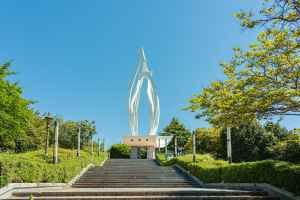
The high point of the greenery around Sinheung-dong and Dongguksa Temple is Wolmyeong Park. The park spans Haemang-dong, Sinheung-dong and Seonyang-dong. Cherry blossoms and camellias bloom in spring, and a walking trail of about 3 km runs gently along the ridge.
Climb to Susi Tower and the observatory on the ridge. The tiled roofs of Sinheung-dong you just walked through and the woods of Dongguksa Temple spread out at a glance, along with the Geumgang River estuary and the West Sea far off. Pass through Haemanggul Tunnel and climb the park trails, or leave your car in the Dongguksa Temple parking lot and combine the alleys with the mountain paths, and you have a solid half-day walking course.
- Wolmyeong ParkHours 09:00–18:00
- Dongguksa TempleClosed days Open all year
The 5 places in this column
-
1
Japanese-style House in Sinheung-dong, Gunsan (Hirotsu House)
An L-shaped 2-story wooden house built by the Japanese landowner Hirotsu in the colonial period. Its Japanese garden and stone lanterns remain in their original form.
- Hours
- 10:00–17:00Last entry 20 minutes before closing more
- Closed days
- Every Monday
- Fee
- Free

-
2
An old alley village on the slopes of Wolmyeongsan Mountain behind Sinheung-dong. Former refugee homes have been revived as artists' studios and exhibition halls.
- Hours
- Always open
- Closed days
- Open all year
- Fee
- Free

-
3
Founded in 1909, it is the only Japanese-style temple in Korea. Together with its girl statue and giant bamboo grove, it is open all year round with no closing days.
- Hours
- Summer 08:00–19:00Winter 08:00–18:00
- Closed days
- Open all year
- Fee
- Free
-
4
Daeungjeon Hall of Dongguksa Temple, Gunsan
A square Buddhist hall built in 1913, 5 bays wide and 5 bays deep. It shows Edo-period architecture, with a 75-degree roof and monks' quarters linked by a corridor.
- Hours
- Summer 08:00–19:00Winter 08:00–18:00
- Closed days
- Open all year
- Fee
- Free

-
5
A downtown park that wraps around Sinheung-dong and Haemang-dong. From its ridge trail of about 3 km and its observatory, you can look out over downtown Gunsan and the West Sea.
- Hours
- 09:00–18:00
- Closed days
- Open all year
- Fee
- Free

Photos: Korea Tourism Organization · KOGL Type 3 (no changes allowed), KOGL Type 1