Gunsan columnsHistory & ArchitectureTraditional Temples, Confucian Academies and Local Confucian Schools7 min read
Choe Chi-won's Reading Voice and the Eaves of Joseon: From Jacheondae Pavilion at Okgu Hyanggyo to Sangjusa Temple and Eunjeoksa Temple
We link ancient and medieval heritage: Jacheondae Pavilion of Silla's Goun Choe Chi-won, Okgu Hyanggyo, the Joseon wooden Buddha halls of Sangjusa Temple and Daeungjeon Hall of Buljusa Temple, and Oseongsan Mountain.

If the modern buildings after the port opening are Gunsan's front cover, the traditional temples, local Confucian schools and Confucian academies that have come down through Baekje, Silla, Goryeo and Joseon are the city's deep roots.
We walk along a thousand years of eaves. In Okgu-eup are Jacheondae Pavilion, where Goun Choe Chi-won's reading voice is said to linger, Okgu Hyanggyo and Munchang Seowon (Confucian Academy). Then come Oseongsan Mountain, steeped in the loyalty of Baekje's Five Sages, and Sangjusa Temple, Buljusa Temple and Eunjeoksa Temple, which keep the beauty of Joseon wooden architecture.
The 8 places in this columnFull list

- Fee
- Free

Munchang Seowon (Confucian Academy)
- Hours
- Always open
- Closed days
- Open all year

- Hours
- Always open
- Closed days
- Open all year

- Hours
- 07:00–18:00
- Closed days
- Open all year
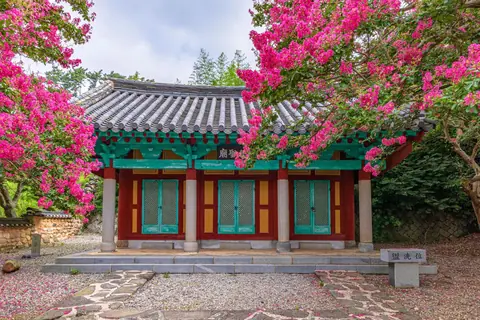
Daeseongjeon Hall of Okgu Hyanggyo (Confucian School)
- Hours
- Always open
- Closed days
- Open all year

- Hours
- 00:00–24:00
- Closed days
- Open all year

Daeungjeon Hall of Sangjusa Temple
Not listed: Hours·Closed days·Fee

Daeungjeon Hall of Buljusa Temple
- Hours
- Sunrise–sunset
Photos: Korea Tourism Organization · KOGL Type 1, KOGL Type 3 (no changes allowed)
“Widen your gaze a little from the red-brick open port, and a pavilion where a Silla writer read and hip-and-gable roofs shaped by Joseon carpenters stand guard on quiet mountainsides.”
Okgu-eup, Which Holds Traces of Goun Choe Chi-won: Jacheondae Pavilion, Okgu Hyanggyo, Munchang Seowon (Confucian Academy) and Oksanwon
Okgu-eup in southwestern Gunsan is a place steeped in the birth legend and scholarly traces of Goun Choe Chi-won (857–?), a great scholar of late Silla. 'Jacheondae Pavilion', a wooden pavilion in the grounds of Okgu Hyanggyo, is said to be where the young Choe Chi-won stayed and read. It is provincially designated cultural heritage material, with a legend that his reading voice was heard even by the Chinese emperor.
Right beside Jacheondae Pavilion, 'Daeseongjeon Hall of Okgu Hyanggyo (Confucian School)', with a gable roof 3 bays wide and 2 bays deep, enshrines the spirit tablets of Confucius and Confucian sages and shows a neat dignity. Also look around 'Munchang Seowon (Confucian Academy)' on nearby Gwangwol-gil (named after Marquis Munchang, Choe Chi-won's posthumous title) and 'Oksanwon' in Sangpyeong-ri (built in 1929, enshrining Choe Chi-won and 14 local sages). Then you can read at a glance the intellectual history of the Okgu Confucian scholars over a thousand years.
- Jacheondae PavilionFee Free
- Munchang Seowon (Confucian Academy)Hours Always open
- OksanwonHours 00:00–24:00
- Daeseongjeon Hall of Okgu Hyanggyo (Confucian School)Hours Always open
The Graceful Curves of Joseon Wooden Buddha Halls: Daeungjeon Hall of Sangjusa Temple, Daeungjeon Hall of Buljusa Temple and Eunjeoksa Temple
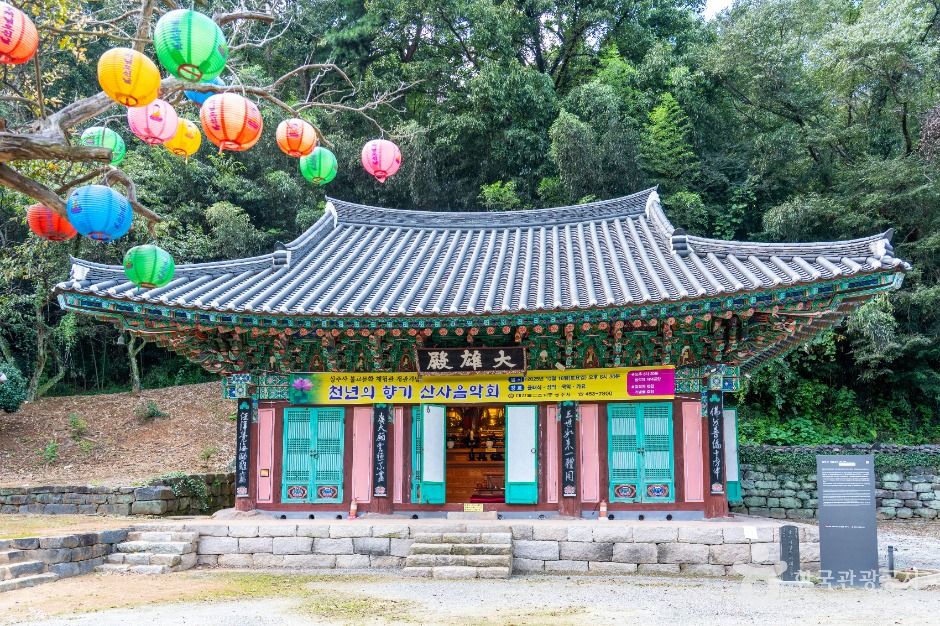
To find the quiet eaves of traditional Korean temples, in contrast to the Japanese-style temple Dongguksa Temple in the old downtown, head to the mountainsides of Seosu-myeon, Napo-myeon and Soryong-dong. 'Daeungjeon Hall of Sangjusa Temple' in Seosu-myeon is a Joseon-period wooden Buddha hall rebuilt in 1641 (the 19th year of King Injo), a provincially designated tangible cultural heritage. Its multi-cluster brackets, ornate but not extravagant, and the fine wood carving of the canopy above the altar are the highlights.
'Daeungjeon Hall of Buljusa Temple' on the slopes of Chwiseongsan Mountain in Napo-myeon is also a Joseon-period Buddha hall with a hip-and-gable roof, 3 bays wide and 2 bays deep (a provincially designated tangible cultural heritage). It keeps the stillness of a deep mountain temple. If you want somewhere close to downtown, 'Eunjeoksa Temple', a thousand-year-old temple on the slopes of Seollimsan Mountain in Soryong-dong (49 Seollim 3-gil), is a welcome find. It is open 07:00–18:00 every day, so it is easy to stop by on a walk in Wolmyeong Park.
- Daeungjeon Hall of Sangjusa Temple
- Daeungjeon Hall of Buljusa TempleHours Sunrise–sunset
- Eunjeoksa TempleHours 07:00–18:00
Oseongsan Mountain, with the Tombs of Five Baekje Generals and a View over the Geumgang River
The place that turns Gunsan's clock back to the Three Kingdoms period is 'Oseongsan Mountain', which rises 227 m above sea level in Seongsan-myeon. On the summit ridge lie side by side the five tombs of the five generals (the Five Sages) who fought to the end for their country and died when Baekje fought the Silla-Tang allied forces in 660.
A road runs to near the summit, so access is easy. From the summit observatory, the slow-flowing Geumgang estuary, the Napo fields and the West Sea spread out in a panorama, and it counts among the leading spots for sunrise and sunset.
- Oseongsan MountainHours Always open
Touring Traditional Heritage from Okgu-eup in the Southwest to Seongsan-myeon and Seosu-myeon in the Northeast
These heritage sites fall into two broad areas. If you are on the way southwest to the Gogunsan Islands or Bieung Port, it is efficient to group Jacheondae Pavilion, Daeseongjeon Hall of Okgu Hyanggyo (Confucian School), Munchang Seowon (Confucian Academy) and Oksanwon in Okgu-eup into one course.
If you are traveling around the Geumgang Estuary Bank or Impi Station in the northeast, climb to the top of Oseongsan Mountain for a view of the Geumgang River. Then visit the Daeungjeon Hall of Buljusa Temple in Napo-myeon and the Daeungjeon Hall of Sangjusa Temple in Seosu-myeon in turn for a smooth route.
- Jacheondae PavilionFee Free
- Daeseongjeon Hall of Okgu Hyanggyo (Confucian School)Hours Always open
- Munchang Seowon (Confucian Academy)Hours Always open
- OksanwonHours 00:00–24:00
- Oseongsan MountainHours Always open
- Daeungjeon Hall of Buljusa TempleHours Sunrise–sunset
- Daeungjeon Hall of Sangjusa Temple
The 8 places in this column
-
1
A wooden pavilion in Okgu-eup said to be where the Silla scholar Choe Chi-won read. It is preserved as provincially designated cultural heritage material.
- Hours
- Not listed
- Closed days
- Not listed
- Fee
- Free
-
2
Daeseongjeon Hall of Okgu Hyanggyo (Confucian School)
A ritual building of a Joseon local Confucian school with a gabled roof, 3 bays wide and 2 bays deep, that enshrines the spirit tablets of Confucius and Confucian sages.
- Hours
- Always open
- Closed days
- Open all year
- Fee
- Free

-
3
Munchang Seowon (Confucian Academy)
A Confucian academy on Gwangwol-gil in Okgu-eup, built to honor Marquis Munchang, Choe Chi-won's posthumous title. It is always open, all year.
- Hours
- Always open
- Closed days
- Open all year
- Fee
- Not listed

-
4
A Confucian academy built in 1929 in Sangpyeong-ri, Okgu-eup, that enshrines the spirit tablets of Choe Chi-won and 14 local sages.
- Hours
- 00:00–24:00
- Closed days
- Open all year
- Fee
- Free

-
5
Daeungjeon Hall of Sangjusa Temple
A Joseon wooden Buddhist hall in Seosu-myeon, rebuilt in 1641. It is provincial tangible cultural heritage notable for its fine canopy and bracket style.
- Hours
- Not listed
- Closed days
- Not listed
- Fee
- Not listed
-
6
Daeungjeon Hall of Buljusa Temple
A hip-and-gable Buddhist hall in Napo-myeon, 3 bays across the front and 2 bays on the side. It keeps the graceful proportions of Joseon temple architecture.
- Hours
- Sunrise–sunset
- Closed days
- Not listed
- Fee
- Not listed

-
7
An old temple at the foot of Seollimsan Mountain in Soryong-dong. It opens its quiet grounds 07:00–18:00 every day.
- Hours
- 07:00–18:00
- Closed days
- Open all year
- Fee
- Not listed

-
8
A mountain in Seongsan-myeon with the tombs of five Baekje generals on its 227 m summit. You can view the Geumgang River estuary and the West Sea at a glance.
- Hours
- Always open
- Closed days
- Open all year
- Fee
- Free

Photos: Korea Tourism Organization · KOGL Type 1, KOGL Type 3 (no changes allowed)