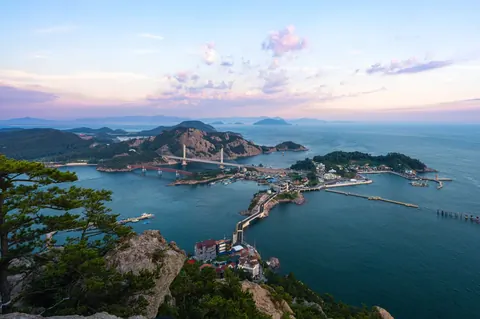
It is linked to Seonyudo Island by Jangjagyo Bridge, so you can walk between them. From this bridge you can see Mangjubong, Jangjabong and Seonyubong peaks, the 8 Views of Seonyu and the sunset. The island has a coastal walking path along a pebble beach and unusual rocks, and the Jangjado Island Port passenger terminal.
Source: Korea Tourism Organization · KOGL Type 1 · 6 photos
Jangjado Island The sea today
Nov 4 (Wed)
Open at all times
Tides
Nearest station · 8.7 km away
Tides · Nov 4 (Wed)
Tide
Time
Height
Low tide
05:15
196 cm
High tide
11:00
469 cm
Low tide
17:32
173 cm
High tide
23:40
526 cm
Shown for seaside places only, when the nearest tide station is within 30 km in a straight line. The curve joins the times and heights of high and low tide.
Sunset
17:35
Sunrise 06:58
Crowd forecast
100 = this place at its busiest
30.19 · Quiet
Forecast by Korea Tourism Organization · received Oct 31
Crowd forecast: A relative forecast where 100 is this place at its busiest; not for comparing places. Quiet 0–39 · Moderate 40–69 · Busy 70 and over — bands set by this site
Walking paths and trails in Gunsan: 15 places, including Gubul Trails 1–4, the 1.8 km Bieung Mapaji Trail, Eunpa Lake Park, Wolmyeong Park and the Seonyudo Trail
Tourist information in Gunsan: 8 tourist information centers, free tours by culture and tourism guides and the 47-point Gunsan stamp tour, with hours, departure times and completion rules
Getting to Gunsan's sights by city bus: route numbers and first and last buses for the Modern History Museum, Gyeongam-dong Railroad Village, Bieung Port, Seonyudo Island, Jangjado Island and Gunsan Airport
Gunsan island ferries: boats to Eocheongdo Island, Gaeyado and Yeondo, and from Jangjado Island to Gwallido, Bangchukdo Island, Myeongdo and Maldo, with daily sailings, fares and ID
Public parking near sights in Gunsan: straight-line distance, spaces and fees for Gyeongam-dong Railroad Village, the Modern History Museum, Chowon Photo Studio, Iseongdang, Dongguksa Temple, Eunpa Lake Park, Seonyudo Island and Jangjado Island
Jangjado Island in detail
Where the name Jangjado Island comes from, and the feng shui story of an 'island that produces great people'
Two stories explain the name Jangjado Island. One says it became Jangjaseom because a strong man was born there. The other says the name combines Gajaemi and Jangjaemi. This small island has produced people who served as a National Assembly member and as a mayor. In feng shui, too, its terrain is read as one that produces many notable people. Jangjado Island has the shape of a horse. Jangjabong Peak rises like a large feed trough in front of a running horse, and the big mountain on Seonyudo Island across the sea wraps around its line of energy.
Jangjado Island's Lion Rock, the Jangja Grandmother Rock legend and the folk songs Geomu Taryeong and Eoreumma Taryeong
Lion Rock is a lion-shaped rock standing tall on Jangjado Island's west shore. It faces the West Sea, and you can see it as you cross the bridge. Islanders believe this rock guards Jangjado Island by blocking misfortune coming from the open sea. Jangjado Island has passed down the tale of Grandmother Jangja and the legends of 'Jangja Grandmother Rock' and 'Hoenggyeongdo Grandfather Rock.' Folk songs such as Geomu Taryeong and Eoreumma Taryeong have also been handed down.
Jangjado Island is the smallest inhabited island in the Gogunsan Islands: a natural shelter harbor and an anchovy port in the '90s
Jangjado Island is the smallest of the inhabited islands in Gogunsan Islands (1st to 3rd by area are Sinsido, Bangchukdo Island and Seonyudo Island). Its natural terrain, not a man-made structure, serves as a shelter harbor. Until about 60 years ago it was the richest island in the Gogunsan Islands. Anchovy fishing grounds no longer form as they once did. But until the late '90s, the Jangjado Island harbor was an anchovy port packed with salted-fish barrels.
Jangjado Island parking lot (145 spaces) and the Jangjado Port ferry terminal location and phone number
The Jangjado Island parking lot holds 145 cars and charges a fee. The Jangjado Island Port passenger terminal is at 47-1 Jangjado-ri, Gunsan-si, and its phone number is 063-464-4614.
Can you walk from Seonyudo Island to Jangjado Island?
Yes. The two islands are linked by Jangjagyo Bridge, so you can go back and forth without a boat. source 1
Is there a parking lot on Jangjado Island?
Yes. The Jangjado Island parking lot has 145 spaces and charges a fee. source 1
What can you see on Jangjado Island?
There is a coastal walking path along a pebble beach and unusual rocks. Lion Rock stands on the island's west shore, facing the West Sea. From the bridge to Seonyudo Island, you can see Mangjubong, Jangjabong and Seonyubong peaks, the 8 Views of Seonyu and the sunset. Many people also come to fish. source 1
Where does the name Jangjado Island come from?
One story says it was called Jangjaseom because a strong man was born there. Another says the names Gajaemi and Jangjaemi were combined into Jangjado Island. source 1
Is there an admission fee for Jangjado Island?
No. It is open all year. Admission is free. If you take a passenger ship, that fare is separate. It is always open, with no closing days. source 2
Can cars use the Jangja Grand Bridge between Jangjado Island and Seonyudo Island?
No, they cannot. The Jangja Grand Bridge between Jangjado Island and Seonyudo Island is for pedestrians only. source 1
Where is the Jangjado Island Port passenger terminal?
It is at 47-1 Jangjado-ri, Gunsan-si. For inquiries, call 063-464-4614. source 1
Is there a fishing village experience village on Jangjado Island?
Yes. The phone numbers for the Jangjado Island fishing village experience are 063-465-0653 and 063-445-0228. source 1


 Jangjado Wharfstraight-line 200 m
 Jangjado Passenger Terminalstraight-line 200 m


 Jangjagyo Bridgestraight-line 310 m
 Jangjagyo Skywalkstraight-line 580 m
 Daejangbong Peakstraight-line 840 m


 Cafe La Pharestraight-line 310 m
 Namdo Bapsangstraight-line 1.5 km
 Seonyudo Beach
 Seonyudo Island
 Gogunsan Islands
 Munyeodo Island
 Mongdol Beach
 Yamido Wharf
 Iseongdang

