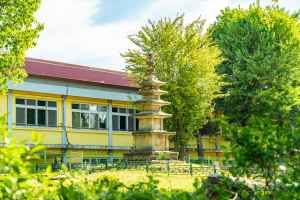
It is thought to date from the Goryeo period. It is said that a Japanese man, Shimatani Yasoya, moved it in 1903 from a nearby abandoned temple site. It now stands with the Stone Lantern in Balsan-ri and the Five-story Stone Pagoda.
Source: Korea Tourism Organization · KOGL Type 1 · 6 photos
6-sided Stupa in Balsan-ri The sea today
Nov 4 (Wed)
Open
Tides
Gunsan station · 21.1 km away
Tides · Nov 4 (Wed)
Tide
Time
Height
Low tide
05:30
205 cm
High tide
11:11
497 cm
Low tide
17:45
186 cm
High tide
23:50
563 cm
Shown for seaside places only, when the nearest tide station is within 30 km in a straight line. The curve joins the times and heights of high and low tide.
Sunset
17:35
Sunrise 06:58
Crowd forecast
100 = this place at its busiest
21.6 · Quiet
Forecast by Korea Tourism Organization · received Oct 31
Crowd forecast: A relative forecast where 100 is this place at its busiest; not for comparing places. Quiet 0–39 · Moderate 40–69 · Busy 70 and over — bands set by this site
Full bar = straight-line 250 m · Within 2,000 m · straight-line distance · Korea Tourism Organization TourAPI
Photos: Korea Tourism Organization · KOGL Type 1, KOGL Type 3 (no changes allowed)
6-sided Stupa in Balsan-ri in detail
The 6-sided Stupa in Balsan-ri is a hexagonal stone stupa, 175 cm tall
6-sided Stupa in Balsan-ri is a stone stupa with a 6-sided plan, 175 cm tall. Among Buddhist stone relics in Korea, examples with this kind of plan are rare. Its style is thought to be Goryeo, influenced by Song dynasty China. It became a Jeonbuk State–designated Cultural Heritage Material on October 31, 2003.
The 6-sided Stupa in Balsan-ri, moved here by Shimatani Yasoya in 1903
6-sided Stupa in Balsan-ri is said to have been brought from a nearby abandoned temple site in 1903 by Shimatani Yasoya, a Japanese man who ran a farm in Gunsan. It now forms a group of relics on the same site as the Stone Lantern in Balsan-ri, Gunsan, and the Five-story Stone Pagoda in Balsan-ri, Gunsan, both national Treasures. It shows one part of how cultural heritage was brought in and rearranged during the Japanese occupation.
6-sided Stupa in Balsan-ri carvings: lotus patterns on each of the 6 faces
The 6-sided Stupa in Balsan-ri has simple carving and good proportions, from the base at the bottom to the finial at the top. Lotus patterns and decorations are finely carved on each face of the 6-sided body. Made of hard stone, it still keeps its shape well after many years.
It is thought to date from the Goryeo period. 6-sided Stupa in Balsan-ri appears to be in a style influenced by Song dynasty China. It became a Jeonbuk State–designated Cultural Heritage Material on October 31, 2003. source 1
What heritage sites are next to the 6-sided Stupa in Balsan-ri?
The Stone Lantern in Balsan-ri, Gunsan, and the Five-story Stone Pagoda in Balsan-ri, Gunsan, both Treasures, stand on the same site. Together with the 6-sided Stupa in Balsan-ri, the three relics form one group. source 1
Does 6-sided Stupa in Balsan-ri have closing days?
No. It is open all year. 6-sided Stupa in Balsan-ri can be seen any day of the year, and parking is available. For inquiries, call 063-454-3267. source 2


 Five-story Stone Pagoda in Balsan-ri, Gunsanstraight-line 40 m
 Stone Lantern in Balsan-ri, Gunsanstraight-line 80 m
 Former Japanese Farm Warehouse in Balsan-ri, Gunsanstraight-line 120 m